Some links on this page are Amazon affiliate links. If you buy through them we may earn a commission at no extra cost to you. It does not change what we recommend.
A ceiling is the easiest surface in the house to estimate and one of the hardest to paint. The arithmetic is one line:
length × width ÷ 400 = gallons per coat
Nothing is deducted. A light fitting is not worth the subtraction.
The common sizes
| Ceiling | Area | One coat | Two coats |
|---|---|---|---|
| 8 × 10 ft | 80 sq ft | 1 qt | 2 qt |
| 10 × 10 ft | 100 sq ft | 1 qt | 2 qt |
| 10 × 12 ft | 120 sq ft | 2 qt | 2 qt |
| 12 × 12 ft | 144 sq ft | 2 qt | 1 gal |
| 12 × 16 ft | 192 sq ft | 2 qt | 1 gal |
| 14 × 16 ft | 224 sq ft | 1 gal | 1 gal + 1 qt |
| 16 × 20 ft | 320 sq ft | 1 gal | 2 gal |
| 20 × 24 ft | 480 sq ft | 1 gal + 2 qt | 2 gal + 2 qt |
A quart covers about 100 square feet, which both This Old House and Bob Vila agree on, and it is why most single rooms are a quart-or-two job rather than a gallon one.
Run your own numbers
The calculator does the arithmetic on this page for your own measurements — a room, one wall, a ceiling, trim, or an exterior.
Open the calculatorOne coat or two
This is the one question where the two most-cited sources disagree outright.
This Old House gives a rule of thumb of two coats on walls and one on the ceiling. Bob Vila says two coats on ceilings — "and you probably should."
Neither is wrong, because they are answering slightly different questions. The practical rule:
One coat when you are putting the same white back over a clean, sound, unstained ceiling. This is most repaints.
Two coats when the ceiling is stained, has been patched, has had a leak, is changing colour at all, or has not been painted in a decade. Also when it is textured, because texture hides unevenly.
The calculator defaults to one and lets you change it, rather than quietly picking a side.
Why ceiling paint is a different product
You can put wall paint on a ceiling. Dedicated ceiling paint is usually better up there for three reasons:
It is flat. Any sheen on a ceiling catches light across the surface and shows every roller lap, every patch and every ripple in the plaster. Flat paint scatters the light instead and hides a great deal.
It is thicker. Ceiling paint is formulated to resist dripping off an upside-down roller, which is a real engineering difference and one you notice within five minutes.
Many are tinted to dry white. They go on faintly pink or blue and fade to white as they cure, so you can see exactly where you have been. Over your head, with no raking light to help, this is worth more than it sounds.
- Ceiling paintFlat, drip-resistant, and often tinted so you can see your wet edgeSee options on Amazon
- Extension poleTurns the whole ceiling into a job you do standing on the floorSee options on Amazon
- Stain-blocking primerWater marks come back through topcoat within days; this is what stops themSee options on Amazon
The stain problem
A brown water mark will come back through two coats of ordinary ceiling paint, sometimes within a day, sometimes a week later when you have put the furniture back.
Spot-prime it with a stain-blocking primer first. Nothing else works, and "one more coat" is the most reliably wasted hour in decorating.
A note on practicalities
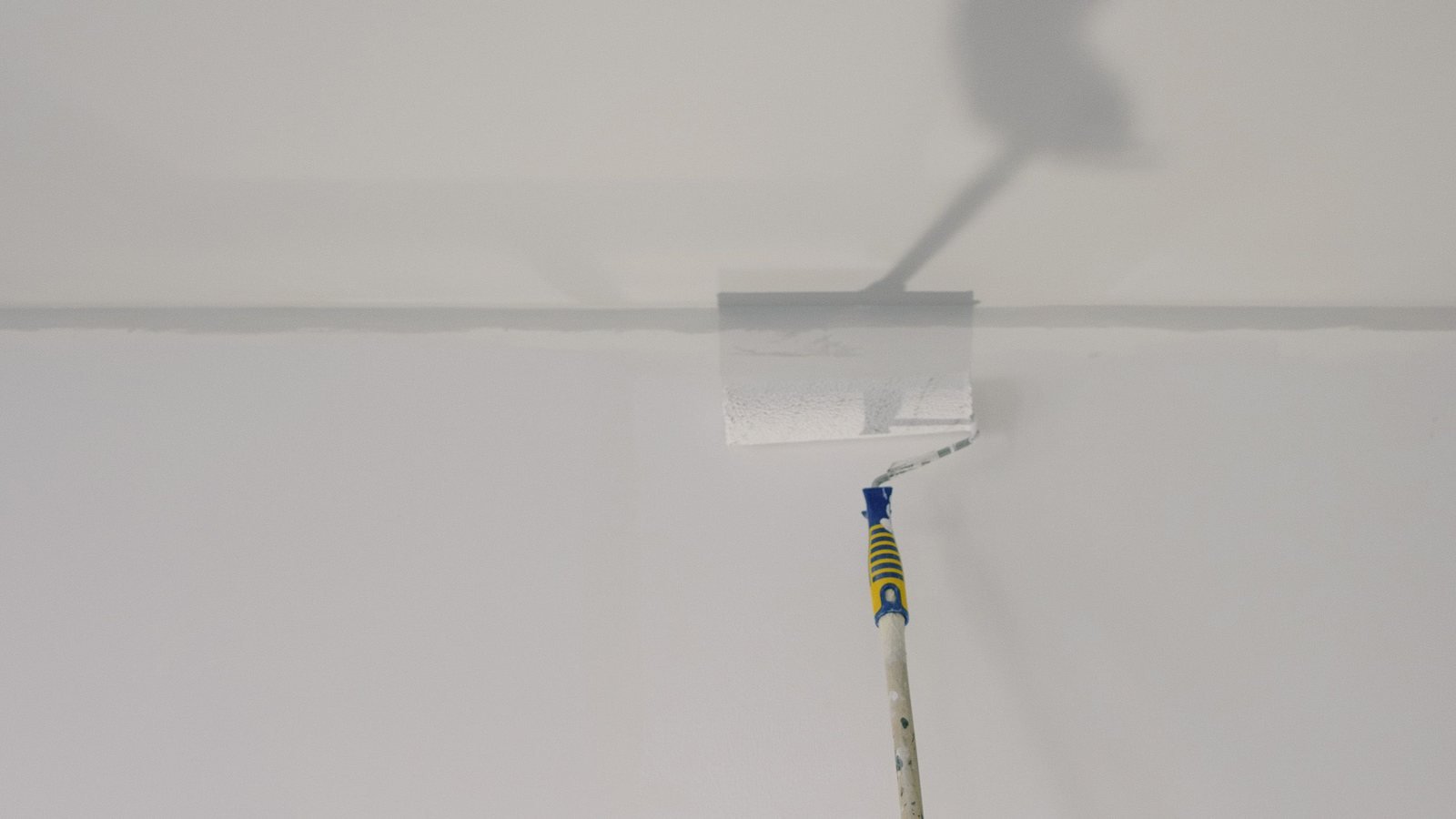
An extension pole is the difference between an afternoon and a weekend, and between a job you do standing up and one you do on a ladder with your neck bent back.
Cut in the edges first, then roll in overlapping strips while the cut-in is still wet, working away from the light. Stopping for lunch in the middle of a ceiling leaves a visible lap line that no second coat quite removes.
Last reviewed November 2026.