Some links on this page are Amazon affiliate links. If you buy through them we may earn a commission at no extra cost to you. It does not change what we recommend.
An exterior is measured the same way as a room — distance around times height — with two differences: you add the gables, and the surface matters far more than it does indoors.
The sum
perimeter × wall height          = main wall area
+ gables and dormers
− doors and windows
= area to paint
A typical single-storey house, 140 ft around, 9 ft to the eaves, with two doors and ten windows:
140 × 9                          = 1,260 sq ft
+ 2 gables at 60 sq ft each      = 1,380
− 2 doors (40) − 10 windows (100) = 1,240 sq ft
× 2 coats                        = 2,480 sq ft
÷ 400 sq ft per gallon           = 6.2 gallons
Call it 6 gallons plus a quart on a smooth, previously painted surface.
Run your own numbers
The calculator does the arithmetic on this page for your own measurements — a room, one wall, a ceiling, trim, or an exterior.
Open the calculatorMeasuring a gable
A gable is a triangle. Its area is half the base times the height — base being the width of the house, height being the rise from the eaves to the peak.
A 30 ft wide house with a 8 ft rise: ½ × 30 × 8 = 120 square feet. Two of them is 240, which is not a trivial addition.
Dormers are small gables plus their side walls, and they are easy to miss entirely. Count them.
For two storeys
Measure the full height from the base of the siding to the eaves, not one floor at a time. A two-storey wall is usually 18 to 20 feet including the band between floors.
| House | Perimeter | Height | Gables | Gallons, 2 coats |
|---|---|---|---|---|
| Small single storey | 120 ft | 9 ft | 100 sq ft | 5 |
| Average single storey | 140 ft | 9 ft | 120 sq ft | 6 + 1 qt |
| Average two storey | 150 ft | 18 ft | 200 sq ft | 13 |
| Large two storey | 180 ft | 20 ft | 300 sq ft | 17 + 2 qt |
Openings deducted at the standard 20 sq ft a door and 10 a window.
The surface changes everything
Indoors the difference between an easy and a hard surface is 400 against 250 square feet a gallon. Outdoors the spread is wider, and texture is the reason.
Smooth siding, previously painted behaves like an interior wall — around 400 square feet a gallon.
Rough-sawn wood, shakes and heavily weathered siding have far more actual surface than their flat dimensions, and the first coat partly soaks in.
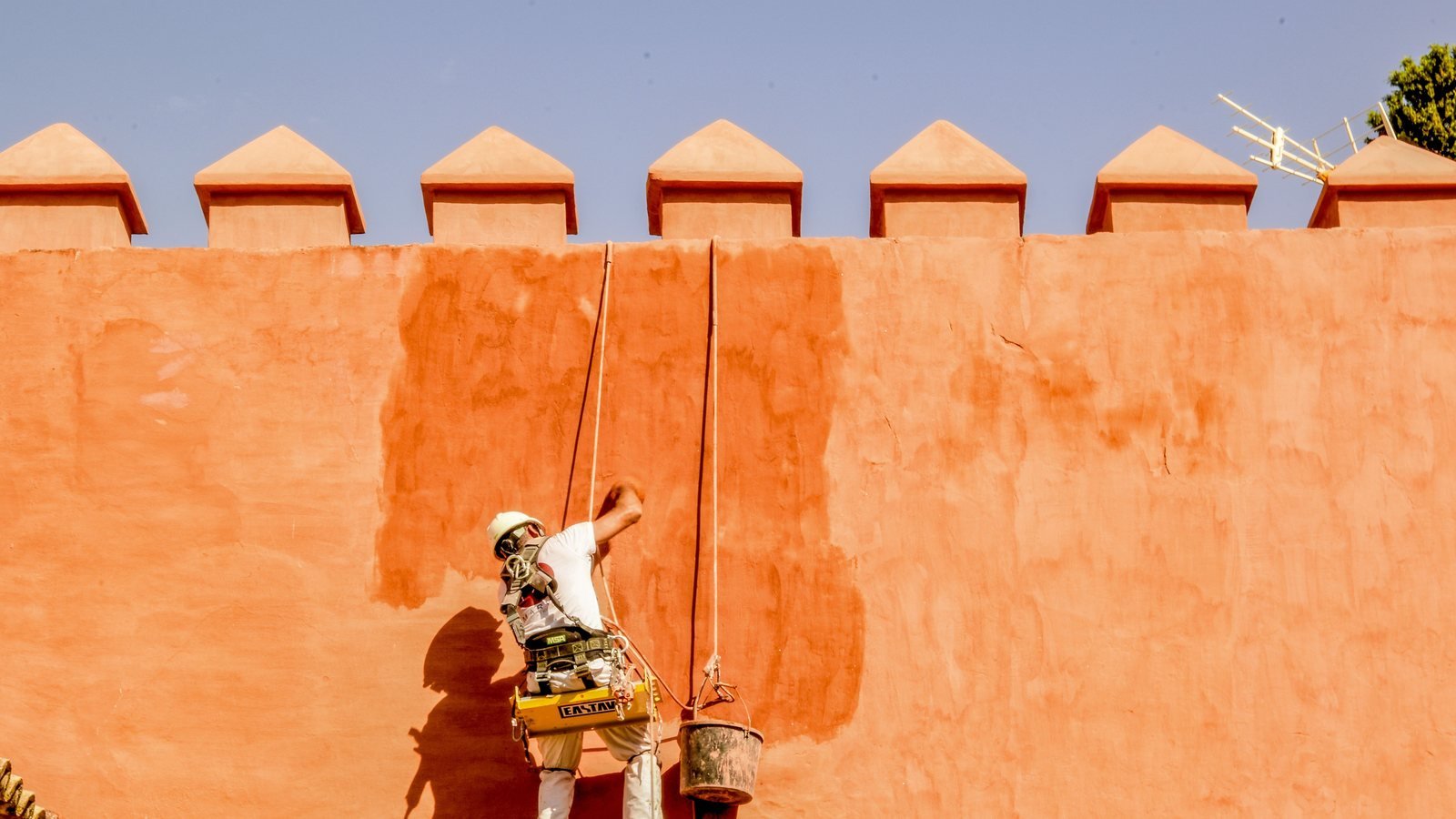
Stucco, render and masonry are the thirstiest of all. The flat area measurement is nearly meaningless on a heavily textured render, and a gallon can go a fraction as far as it would on siding. The tin's figure for masonry paint is the only one worth trusting here.
Brick varies hugely with how porous it is, and the mortar joints add surface that the measurement does not see.
Nothing calculated from length × height can know any of this, which is why the surface setting exists — and why, for anything other than flat siding, it is worth buying the first gallon, painting a measured patch, and working out your own real rate before buying the rest.
- Exterior paintThe tin's spreading rate for your specific surface is the figure that matters outdoorsSee options on Amazon
- Exterior primerFor bare wood, heavy weathering, or anywhere the old coat has failedSee options on Amazon
- Paint sprayerOn a whole house a sprayer pays for itself in days — though it uses more paint than a rollerSee options on Amazon
Buy generously, and buy at once
Exteriors are the worst place to run short. A colour mixed in March and a colour mixed in May can differ enough to see across a wall in daylight, and the wall is the largest thing anyone looks at.
Buy the whole job in one order and box it — pour all the tins into one container and stir — so any batch variation disappears before it reaches the house.
And add 10% on top of whatever the sum says. Outdoors, the bits you did not measure — soffits, fascia, the return behind the downpipe, the back of the garage — always exist.
Last reviewed November 2026.